The Philosopher's Stone indicator live on a TradingView MES futures chart — the master panel with the four divergence tiers, the Seal, a SHORT bias at premium and the confluence readout, over the regime line, supply and demand zones and the moving-average scaffold
Supply zone — bias short
The short
starts here
[ THE PHILOSOPHER'S STONE · MASTER TRADINGVIEW INDICATOR ]

The Stone. The Signal. The Edge.

[ THE STONE · LIVE ON MES · BIAS SHORT · PREMIUM · REGIME BEARISH ]

Precision institutional confluence — location, structure, liquidity, supply & demand and cross-index divergence, resolved into one bias on a single panel.

See how it reads →

Edge without discipline is not edge.

$19/mo · Sphinx + Vigil · cancel anytime · built for US index futures
1
master indicator
4
divergence tiers
9
dimensions in your model
Solo + Desk
two modes, one journal
The Philosopher's Stone
One indicator that reads the market the way a disciplined trader thinks.
[ Sphinx · The Master Read ]

Not a signal — a reasoning

Most indicators hand you an arrow and hope you trust it. The Stone does the opposite: it breaks every potential trade into the same questions a serious intraday trader asks before risking a dollar — and shows you the answers on one clean panel.

  • Tells you the bias — and why. Direction is decided by where price sits in the day's range and how that lines up with fair value. When the two frames agree you get a clean LONG or SHORT; when they conflict, it tells you to stand down rather than force a trade.
  • Grades every setup against six checks. Location, Structure, Imbalance, Liquidity, Supply/Demand and a cross-index divergence read — each a simple colour-coded mark, so an A-grade setup and a coin flip never look the same.
  • Pings you when the board lights up. When enough of the picture aligns in one direction you get an alert — so you're watching price, not babysitting a chart.
  • Maps the bigger picture. An optional regime layer shows the overarching backdrop, kept visually separate so context never gets confused with the signal itself.

Example — the panel reads it back "Bias SHORT at premium — Location and Structure confirmed, but Imbalance, Liquidity and Supply/Demand still unmet, with cross-index SMT leaning short. A developing short, not a fully-sealed one."

[ Why "The Philosopher's Stone" ]

Scattered elements, one refined read

In the old alchemical texts the Stone was the agent that brought scattered elements into a single, refined whole. That is the idea here — the scattered pieces of market structure, resolved into one read.

  • The flagship of the Sphinx Suite. Trinity reads cross-index divergence, Equinox holds the session and timing scaffold, Ledger marks where value lives — and the Stone resolves all three into a single bias, on a single panel.
  • Built for index futures, intraday. Tuned for the index markets and the New York session — for traders tired of charts stacked with ten conflicting tools.
  • Confirms a disciplined read — it doesn't fire blindly. The Stone sharpens your judgment; it never replaces it.
The actual readout
No mock-up, no render — the Stone exactly as it prints on the chart.
The Philosopher's Stone master panel and the confluence box on a live 1-minute MES chart — four divergence tiers, the Seal, BIAS SHORT at premium, the confluence row, the regime line and supply/demand zones
[ THE STONE · LIVE ON MES · 1-MIN · BIAS SHORT · PREMIUM · REGIME BEARISH ]
Why it's different

Most journals log what happened. Vigil studies whether you were the trader you said you'd be. You write the model; the journal holds every trade against it and reflects the pattern back — your discipline, your drift, your edge — without grading you and without telling you what to do. It asks more of you than a spreadsheet. It's built for traders willing to put the work in.

[ Vigil · The Model ]

Define the trader you intend to be

Before the journal can hold you to anything, you set the standard yourself — a nine-dimension charter that is your edge, in your own words.

Example — your signal basis "Cross-index divergence between the correlated index futures, taken only when price reclaims and holds back through the prior imbalance. The divergence sets the bias; the reclaim confirms the entry."

[ Vigil · The Reckoning ]

Then see how you actually traded it

An AI study reads every logged trade against your own charter and reports, condition by condition, where you held the line and where you drifted — in plain counts, never grades or advice.

Example — a finding "Entry trigger, retrace into the reclaimed zone: marked held on 44 trades, partial on 25, missed on 13. Entry-fill location was the most consistently recorded criterion in the sample — partiality indicates some entries were placed on the break rather than the retrace."

What the journal shows you
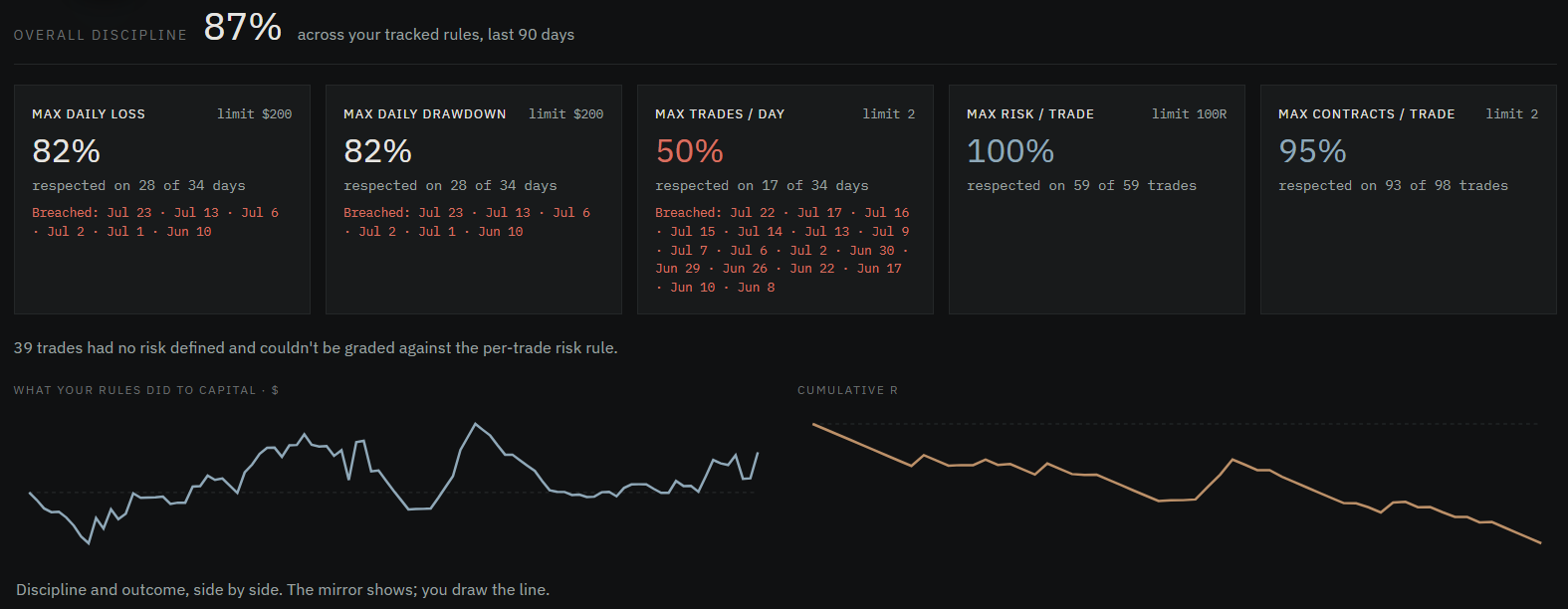
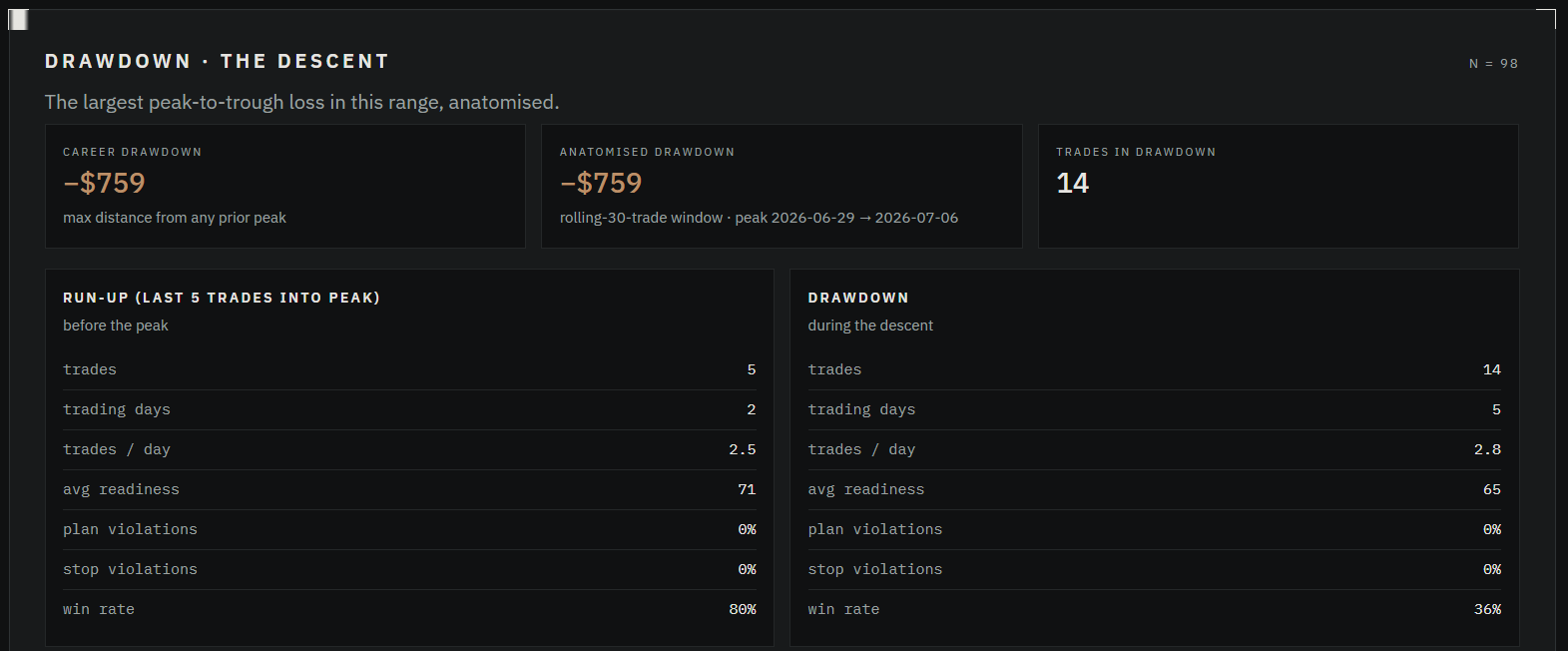
The figures, not a verdict — every number independent of P&L.
Vigil edge analytics — Net P&L, profit factor, win rate, average R, average win and loss, expectancy, max drawdown, and aligned days
[ VIGIL · EDGE ANALYTICS · P&L-INDEPENDENT ]
Vigil performance calendar — daily profit and loss, trade counts, and a readiness mark on each trading day
[ VIGIL · THE LEDGER · DAILY P&L + READINESS ]
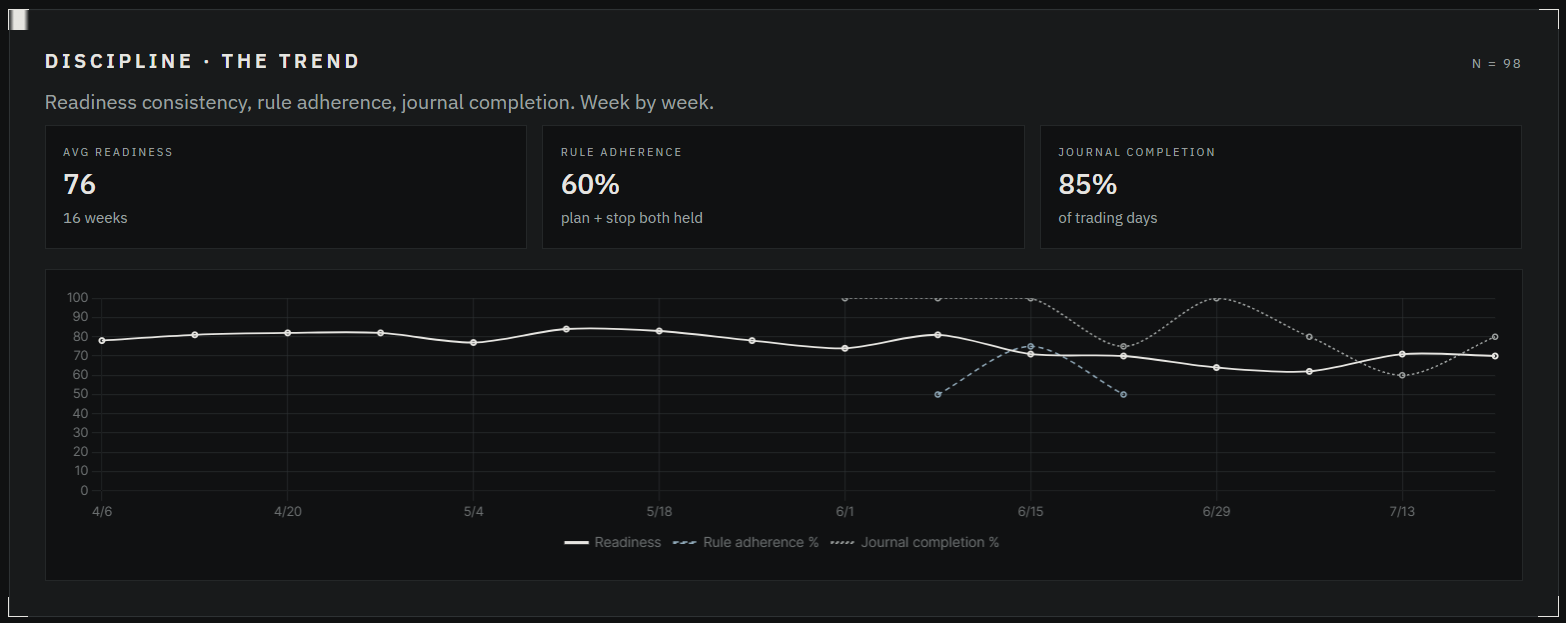
Vigil discipline trend — readiness consistency, rule adherence, and journal completion charted week by week
[ VIGIL · THE MIRROR · DISCIPLINE TREND ]
What's inside
Two instruments. One subscription.
[ I · THE INDICATOR ]
The Philosopher's Stone
The master read.
One TradingView indicator that resolves location, structure, liquidity, supply/demand and cross-index divergence into a single bias on a single panel. The flagship of the Sphinx Suite — Trinity, Equinox and Ledger are the engines inside it, not three things to juggle.
Bias engine — range location read against fair value, premium / discount aware
Six-check confluence — Location · Structure · Imbalance · Liquidity · S/D · SMT
Trinity SMT — cross-index divergence across four time tiers, T1–T4
The Seal + confluence alerts — a ping when the board aligns
Optional regime layer · TradingView access included with subscription
[ II · JOURNAL ]
Vigil
The discipline ledger.
A journal for traders who do the work: it reads every trade against the model you define and reflects back where you kept to it and where you drifted — a study of the model, and of the trader running it. It shows; it never grades.
Dashboard — the day ahead, your trades, the ledger calendar
The Model — a nine-dimension charter you write, then measure trades against
The Reckoning — an AI study of how your trades track your model, observed not judged
Mirror — profit factor, expectancy, R-multiple, discipline trend
Desk — share a model with your crew. Optional, same subscription

Futures trading journal — common questions

Is Hermetic Trader a trading journal?

Yes. At its core, Vigil is a futures trading journal built for ES, NQ, MES and MNQ traders. It logs every trade, tracks your daily readiness, and measures what you did against the model you defined.

Does it work with TradingView and prop-firm accounts?

Yes. The Philosopher's Stone runs on TradingView, and the journal imports Tradovate CSVs, so it fits how most funded and prop-firm futures traders already work. Trades are logged against your own rules, not a generic template.

How is it different from other trading journals?

Most journals grade you on profit and loss. Hermetic Trader measures every trade against the model you define and reflects back where you held your discipline and where you drifted. It shows the pattern; it never grades you.

"Most traders fail not because they lack signals, but because they lack the discipline to follow them. Hermetic Trader is built for the half of trading that lives between the ears."

$19/mo · The Philosopher's Stone + Vigil journal + Desks · cancel anytime